

We’re modernizing the infrastructure in our little town of about 9,000 people. Multiple projects on multiple streets are happening at once.
It means a lot of disruption. Roads are closed and open and then closed again. Our downtown is full of orange barrels. Traffic often comes to a crawl.
People are losing their damn minds.
Listen, construction is hard. No one likes it.
But already, it’s halfway finished and I can see how nice it will be. Underground utilities. A dedicated left turn lane. A wide brick promenade-style sidewalk, with plenty of room for outdoor dining. People will be able to safely stroll down the street, instead of squeezing into a few feet of half-broken sidewalk.
Our community has been asking for a major investment in our downtown for decades. Still, change is still uncomfortable for some citizens. They take to Facebook to air their grievances and call the city incompetent.
For every post that complains, there’s another post by someone who calmly explains the facts and reiterates that yes, it is uncomfortable, but it will be worth it.
For me, it’s a fascinating little study in what it means to endure discomfort. What motivates some people to sit with and even embrace discomfort, while others spend their energy on avoidance or blame?
Maybe you have a discomfort in your life right now, and you’re spinning around in fight/flight/freeze. I’ve been there. I am there.
I have some things that might help. The 4 big reasons humans are able to withstand discomfort.
1. Because the greater good needs you
On September 7, 1940, Hitler’s Germany bombed London, killing more than 400 people. For 57 consecutive nights, Germany dropped bombs on the city.
Over 9 months, more than 43,000 people were killed in The Blitz. Londoners sent their children away to safety, and sought shelter wherever they could, including sleeping in Tube stations.
It was horrific, but they never surrendered. Stoic Brits. Keep calm and carry on.
In December of 1955, the Montgomery Improvement Association, led by Dr. Martin Luther King, Jr., organized the Montgomery Bus Boycott to protest segregation on city buses.
For an entire year, Black residents in Montgomery, Alabama, avoided taking the bus. It came at a great personal cost and was extremely inconvenient. But the boycott created massive economic pressure, ultimately leading to the Supreme Court ruling that segregation on buses is unconstitutional.
Two different groups of humans. Two different kinds of discomfort. Both in the service of something bigger. Collective discomfort towards a collective goal, associated with the greater good.
This is the type of discomfort we lionize. The resilience of the human spirit kind.
2. Because you care about something
Originally, I thought my city’s construction fell into the “greater good” category. Then I realized that while it is collective discomfort, not everyone agrees it’s for the greater good.
And also, it’s freaking construction, not a noble fight for freedom.
Why do I simply sigh and take the posted detour with only a shrug of my shoulders, while someone else loses their mind and resorts to conspiracy theories about bribery of city officials? (I wish I was kidding.)
Am I just a better human?
I’d like to say, “Yes, please admire my virtue!” But the reality is, the discomfort is worth it to me because of my personal values.
I value living in a modern city. I value progress and economic development. It’s less about the collective about more about my values.
Similarly, valuing my health is what drives me to do extremely uncomfortable HIIT workouts, involving 2 solid minutes of burpees. It’s why I’ve been a runner for 30 years. I crave this discomfort because it signals that I’m focused on a value I care about.
This is why some people willingly go through childbirth with no pain medication. I am not of those people, because that discomfort doesn’t align with a value for me. But a marathon? Yeah, I’ll take that pain.
3. Because you see the potential for growth
A 2022 study called Motivating Personal Growth by Seeking Discomfort put people in a variety of uncomfortable situations, like doing improv exercises at Second City in Chicago.
Instructors gave some of the students the normal instructions for improv. Then, they told another group their goal was to feel uncomfortable and awkward.
The students who had explicitly been told to seek discomfort were more persistent and took more risks. (There’s a good plain language story here.) What I get from this is that when you’re transparent with yourself that something will be uncomfortable, it frees something up in you.
This reminds me of some of the research I did for my 2020 book on honesty.
I interviewed Emma Levine, assistant professor of behavioral science at the University of Chicago Booth School of Business, and Taya Cohen, associate professor of organizational behavior and theory at Carnegie Mellon University’s Tepper School of Business. They are both brilliant and have conducted various studies on honesty and discomfort.
My favorite is when they asked one group of people to aim for complete honesty in all their conversations for the next three days. They told the other group to just be kind.
The complete honesty group had a real WTF moment. They predicted honesty would be terrible, would potentially ruin relationships, and would take away a coping mechanism for dealing with awkward situations.
You know what? They were wrong. They actually felt good. Their conversations were more meaningful. Was it always comfortable? Absolutely not. But was it worth it? Yes.
4. Because sitting with it is all that’s left to try
My 18-year-old son is tackling some difficult issues he can no longer avoid. “I’m learning to sit with my discomfort,” he said to me.
“Me too,” I responded.
We’ve basically both run out of other options.
He’s finally understood that some of the problems he has won’t just disappear by ignoring them. And I’ve finally understood that I can’t solve his problems.
Aren’t we an adorable pair?
The discomfort of seeing someone you love struggle is hella hard. Not harder than bombs or institutional racism. But harder than marathons and HIIT workouts.
Meditation is supposed to help in these situations. Breath is fine and all that, but I’m a word person.
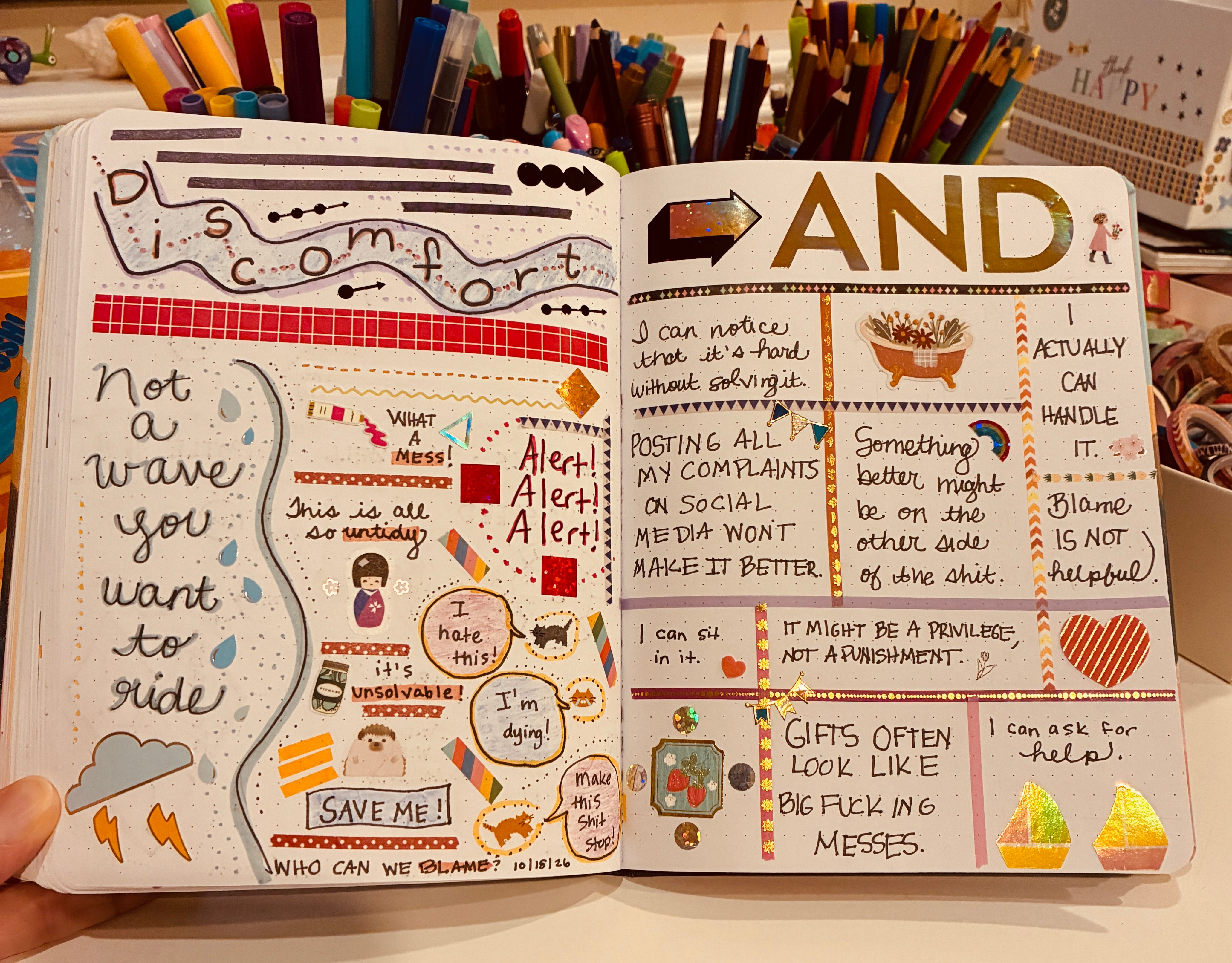
So I’ve been learning to practice radical acceptance, and something called equanimity in how I think of and speak of my discomfort.
Instead of simply breathing and focusing on the present (mindfulness), I say in my mind (or sometimes aloud) what the discomfort is, stating it as a fact, without emotion, and then make an AND statement, like, “I wish things were different, AND I can work with what is true today.”
Pretty simple. But it’s surprisingly powerful.
In fact, research from Carnegie Mellon’s Health and Human Performance Lab shows that people who do these kinds of acceptance and equanimity exercises can lower their biological stress responses. They also report higher positive emotions and well-being.
I’m a fan of less stress and more positive emotions. How hilarious that discomfort is the path there! And you know they’ll be a shit ton of construction along the way.
Go be uncomfortable and report back.
Some Stuff I’ve Written Lately
I wrote my latest Cincinnati magazine column about how I might want to be a hiker. Maybe it will inspire you to get outside before the weather turns to shit.

***
I had the pleasure of writing about a new coffee house here in my neighborhood. If you’re in the Cincinnati area, definitely stop by! There’s a great story behind the place the coffee and treats are THE BEST.

***
I love interviewing smart people. I was in luck this year, because I had the chance to talk to about a dozen graduates of the McCourt School at Georgetown for this piece about the value of a public policy degree.

***
Know of an organization looking for content help?
I do all kinds of writing, but one of the main things I do is help organizations with their digital content.
Specifically, I work with lots of hospitals and healthcare systems to improve their web content or write things like patient stories or annual reports.
Learn more about me, if you want.

Ugh! This makes so much sense! 😂 it’s exactly the post I needed, and coincidentally I read a post earlier this week about how we need to learn to live with discomfort in publishing if we want to make it. That was pretty powerful, when put together with your post. Thank you for this!